The Invoice Nobody Sees: What Manual Work Really Costs
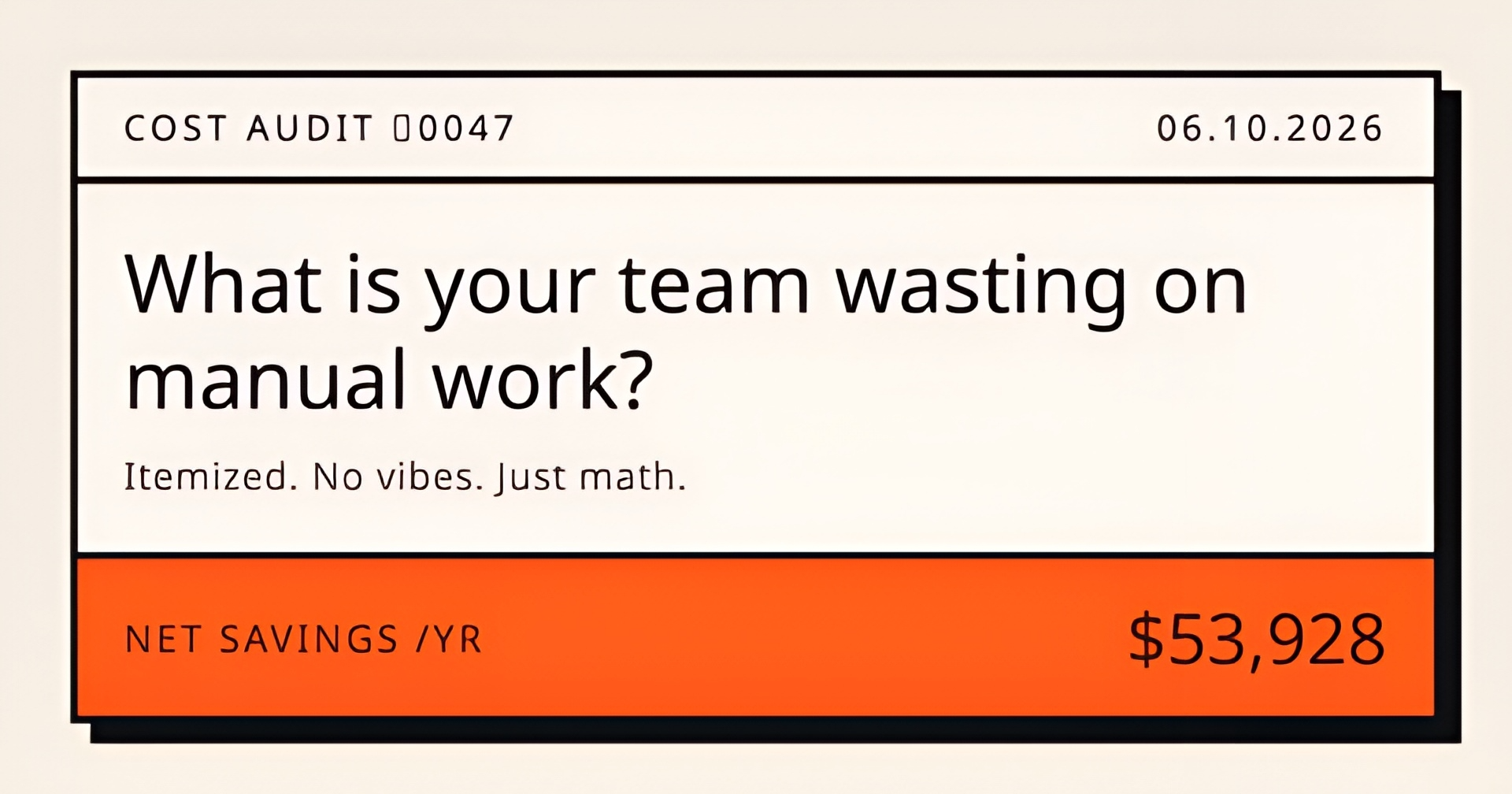
There's a bill your business pays every month that has never once shown up in your accounting software.
No line item. No invoice number. No due date. It just quietly leaves your bank account disguised as payroll, and because it's disguised as payroll, nobody ever questions it.
I'm talking about the cost of manual work. And before you skim past that phrase — because you've heard some version of it in every SaaS ad since 2019 — let me show you why the number attached to it is almost certainly bigger than the one in your head.
The math you've never actually run
Here's a real composite from the DTC brands I work with as a fractional CMO. Mid-six-figure to low-seven-figure store, lean team, founder still in the weeds:
- Pulling and reformatting the same reports every week: ~4 hours
- Copy-pasting between the store, the email platform, and the spreadsheet that holds it all together: ~6 hours
- Manually segmenting, tagging, and cleaning customer data: ~5 hours
- Chasing follow-ups that a system should have sent: ~7 hours
That's 22 hours a week. At a loaded cost of $48/hour — salary, taxes, software seat, the works — you're looking at roughly $4,200 a month. Call it $50,000 a year.
Fifty grand. For work that produces nothing new. No new customers, no new products, no new revenue. Just information being moved from one box to another by a human being who was hired to do something smarter.
Now here's the uncomfortable part: when I ask owners to estimate this number before we run it, they guess low. Not a little low. Low by about half.
Why your brain hides this number from you
This isn't a math failure. It's a visibility failure, and it has a specific mechanism.
When a cost arrives as an invoice — your agency retainer, your software stack, your 3PL bill — it gets scrutinized. You see the number, you feel the number, and once a year you try to negotiate the number.
But when a cost arrives distributed — sliced into 15-minute fragments across five people's calendars, buried inside salaries you already decided were justified — it never assembles itself into a figure you can react to. There's no moment of sticker shock because there's no sticker.
Psychologists call the broader effect "pain of paying." You feel a $500 invoice more than $4,200 of invisible labor, for the same reason you feel a parking ticket more than your insurance premium. One is itemized. One is ambient.
Your manual work cost is ambient. Which means the only way to ever make a decision about it is to force it onto paper.
There's finally a tool that prints the receipt
A while back I came across an AI cost savings calculator that does exactly one thing, and it has quietly become the fastest way I know to make this number real: it itemizes the invisible invoice. I point people to it constantly now, because seeing the figure does more in sixty seconds than an hour of me explaining it ever could.
Three questions. Sixty seconds. It takes your team's hours of repetitive work, your loaded hourly cost, and current automation pricing across industries, and hands you back an audit — itemized like a receipt, because that's what it is.
See your number in 60 seconds
Three inputs. Your loaded hourly cost. The hours your team spends on repetitive work. That's it.
Run your cost audit hereWhat I like about it is what it doesn't do. It won't tell you that "AI will transform your business" — and I'm as tired of that sentence as you are. It just tells you a number. What you do with the number is your call.
But I'll make a prediction: the figure it shows you will be bigger than the one you just guessed. Across nearly everyone I've watched run it, it lands higher than the gut estimate — often dramatically.
And here's why this matters more now than it did even a year ago. The kind of work quietly draining your week — the report-pulling, the data cleaning, the follow-up chasing — is exactly the kind of work AI automation has gotten genuinely good at. The tooling is cheaper, faster, and more capable every single quarter. The mundane, repetitive tasks you've always just absorbed as "the cost of doing business" are, for the first time, the easiest things in your business to hand off. Most owners simply haven't stopped to notice yet — and what's possible right now is honestly kind of amazing.
What the number is actually for
A quick word on what not to do with your result, because this is where most "automation savings" conversations go off the rails.
The number is not an instruction to fire anyone. The brands I work with that get this right don't cut headcount — they reallocate it. The 22 hours stop going into copy-paste and start going into the things that actually move revenue: creative testing, customer conversations, offers, retention. The savings figure is really a reinvestment figure wearing a disguise.
It's also not a promise that automation captures 100% of it. Realistically you reclaim 60-80% — tools cost money, setup takes time, and some manual work is genuinely worth keeping human. The calculator nets out tooling costs for exactly this reason. I'd rather show you a conservative real number than an impressive fake one.
What the number is: the first honest line item for a cost you've been paying blind. You can't manage what you've never itemized.
Run it before you forget
Here's what happens to most people who read a post like this: they nod, they agree, they think "I should figure that out sometime," and the tab closes. The invisible invoice stays invisible, and it gets paid again next month, and the month after.
The whole audit takes less time than it took to read this far.
Get the receipt
Three inputs. Your number. Itemized. And if the number makes you want to do something about it — that's the part I do for a living. But first, get the receipt.
See what manual work is costing you →Share this article:
Tags:

About Michael Cocan
Fractional CMO with over a decade of experience managing $100M+ in ad spend and building 8-figure customer acquisition funnels. Helping growth-stage brands break through revenue ceilings.
Work with Michael →